13 July
Development
Custom Website vs Website Builder: WordPress, Shopify, or Custom Code?
- Blackdot
- 0 Comments
Custom Website vs Website Builder: WordPress, Shopify, or Custom Code?
Choosing how to build your business website is one of the most important digital decisions you will make.
Get it right, and your website becomes a lead-generating, trust-building asset that works for you around the clock. Get it wrong, and you end up locked into a platform that limits your growth, costs more than expected, and needs replacing sooner than it should.
This guide gives you a straight answer. No jargon. No sales pitch. Just a clear breakdown of what WordPress, Shopify, and custom web development each offer, and which one fits your business right now.
TL;DR WordPress is best for content-driven businesses that want flexibility, strong SEO, and full ownership. Shopify is best for online stores that need to sell and scale. A custom-built website is best when your business needs unique functionality, a distinctive brand, or a platform that grows with you without restrictions. For most South African SMEs, WordPress is the practical starting point. For serious e-commerce, Shopify. For everything else, custom.
What Are the Three Options?
Let us start with a quick definition of each.
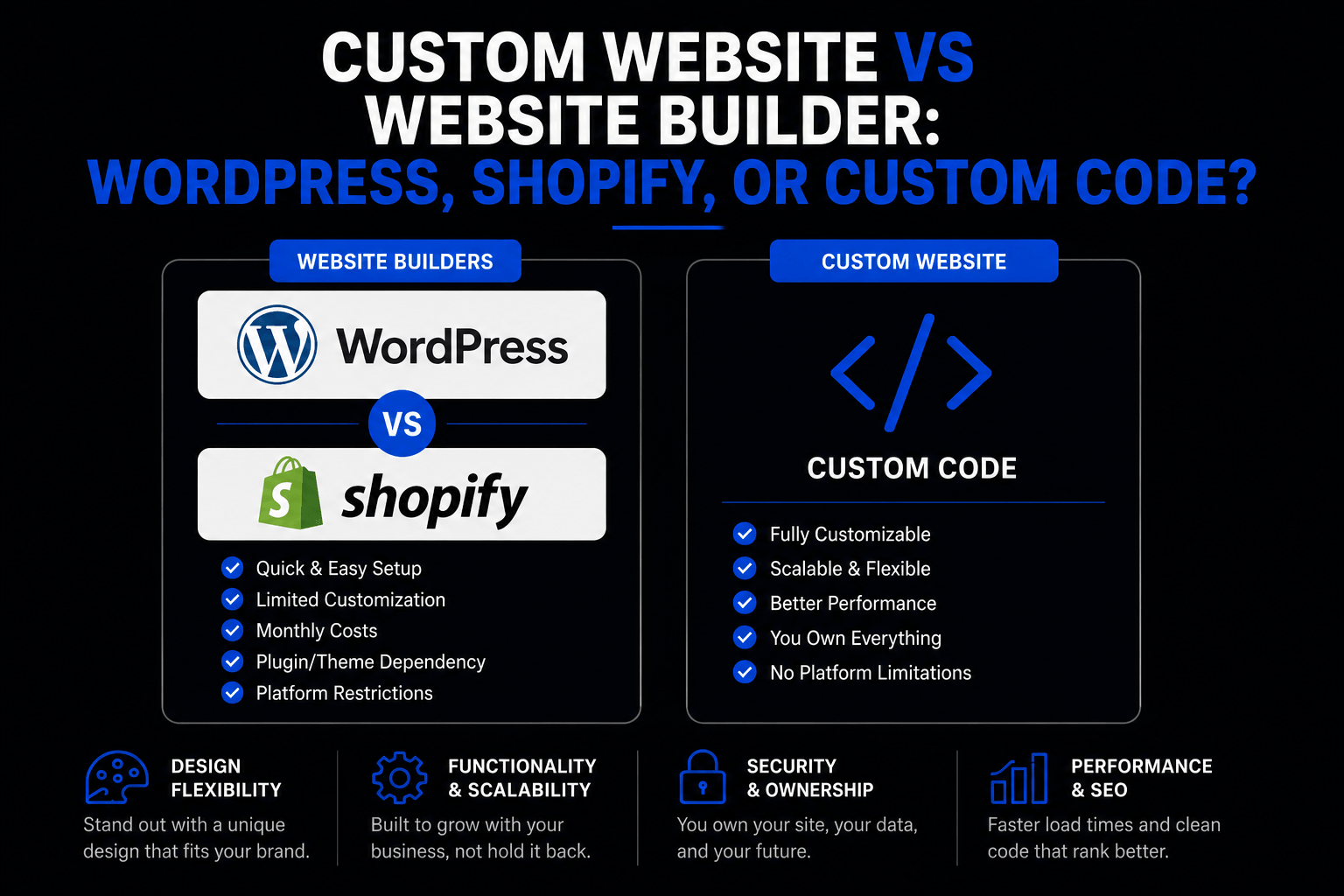
WordPress
WordPress is an open-source content management system (CMS) that powers over 43% of all websites on the internet. It is the most widely used web platform in the world.
It gives you full control over your hosting, design, code, and plugins. You can build anything from a simple blog to a full e-commerce store using WooCommerce. It is highly flexible, but it does require some technical know-how or a developer to manage it properly.
Best known for: Blogging, business websites, SEO performance, content management.
Shopify
Shopify is a dedicated e-commerce platform built entirely for selling online. It handles product management, inventory, payments, shipping, and multi-channel selling out of the box.
Shopify powers approximately 5.9 million live websites worldwide and processes over $292 billion in sales annually. If selling products online is your main focus, Shopify is purpose-built for exactly that.
Best known for: Online stores, product catalogues, e-commerce at scale.
Custom Web Development
A custom-built website is designed and built from scratch, specifically for your business. There are no templates, no platform restrictions, and no borrowed code.
Every page, every feature, and every interaction is built around what your business actually needs. Custom development offers complete control over design, performance, security, and functionality, and it scales with you without hitting platform ceilings.
Best known for: Unique functionality, brand-led design, long-term scalability, technical SEO control.
How Do They Compare?
Cost Over Time
This is where most people get misled. The upfront price is only part of the picture.
WordPress is free to use, but you pay for hosting, a premium theme, and plugins. A professionally built WordPress site in South Africa typically costs between R15,000 and R40,000 to set up, with monthly hosting from R300 to R1,500.
Shopify charges a monthly subscription. Plans run from approximately R750 to R7,500 per month in rand terms, before apps and transaction fees. The average Shopify store uses six paid apps at between $15 and $50 each per month, so costs add up fast.
Custom websites have a higher upfront investment, typically starting from R30,000 to R80,000 for a quality build. But you own the asset outright, with no recurring platform fees and no risk of the platform changing its pricing or terms.
The key question is not what you pay today. It is what you own in three years.
With WordPress and custom development, you own everything. With Shopify, you are renting access to a platform. If you decide to leave, migration is difficult and disruptive.
Find your best-fit website platform
What's your main goal?
What's your budget?
What matters most?
Will you or the client be updating content after launch?
Best fit for you
Get advice on thisSEO and Search Performance
SEO is where platform choice has the most direct impact on your business growth.
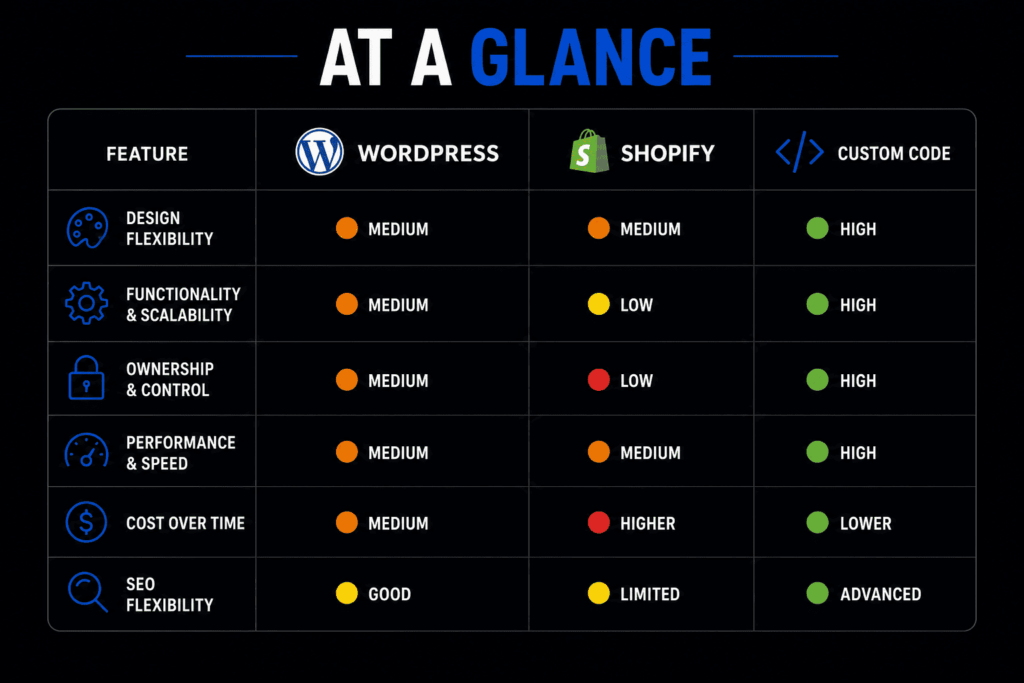
Custom-built sites consistently outperform platform sites on technical performance. A 2025 HTTP Archive analysis found that the median website builder site scored 62 on Google PageSpeed Insights for mobile, compared to 85 for custom-built sites. That gap directly affects your search rankings and conversion rate.
WordPress is excellent for SEO when set up correctly. Plugins like Yoast SEO and Rank Math give you granular control over meta tags, schema markup, sitemaps, and page structure. The trade-off is that WordPress does not optimise itself automatically. You need a lightweight theme, proper caching, compressed images, and controlled plugin use to get the best performance.
Shopify handles e-commerce SEO competently for most stores. However, it imposes limits on URL structure, canonical tags, and advanced technical configurations that can hold back larger stores competing for high-volume keywords.
For businesses where organic search is a primary growth channel, a custom-built website gives you the most control and the highest performance ceiling.
Design and Brand Identity
WordPress offers thousands of themes, free and premium. Page builders like Elementor give non-technical users a lot of design flexibility. But when thousands of businesses use the same themes, it becomes harder to stand out.
Shopify has a more focused theme library built around e-commerce layouts. The designs are clean and conversion-focused, but customisation beyond the template structure requires developer input.
Custom websites are built entirely around your brand. Every colour, layout, interaction, and detail reflects your specific positioning rather than a template default. If your brand experience is a competitive advantage, this is where custom development pays for itself.
Scalability and Functionality
WordPress scales well for content-heavy sites and mid-sized WooCommerce stores. The challenge at scale is plugin management. More plugins mean more conflicts, more security patches, and more performance work. As your site grows, so does the technical overhead.
Shopify scales well for e-commerce volume. It handles large product catalogues, multi-channel selling, and high transaction volumes reliably. The cost, however, grows alongside your store as you add apps and move up subscription tiers.
Custom development has no ceiling. Need a custom booking system? A loyalty programme? API integrations with your CRM or accounting software? A multilingual site with local South African language support? All of it can be built exactly as needed, without workarounds or third-party plugins that may not be maintained.
Which One Is Right for You?
Here is a simple decision framework based on where your business actually is.
Choose WordPress if:
- You need a flexible, content-driven website with strong SEO foundations
- You publish regular blog posts, resources, or news and need a capable CMS
- You want design flexibility without the cost of full custom development
- You need a WooCommerce store without the ongoing subscription cost of Shopify
- You have a developer or agency who can manage the technical side
Choose Shopify if:
- Selling products online is your primary business model
- You have a growing product catalogue that needs proper inventory management
- You want to sell across multiple channels like Instagram, TikTok, and Amazon
- You need features like abandoned cart recovery, subscription products, and detailed sales analytics
- You want a reliable, managed platform without server-level technical management
Choose a custom-built website if:
- Your brand experience is central to how you compete
- You need functionality that no plugin or template can replicate
- SEO is a primary growth channel and you need full technical control
- You are planning significant growth and need a platform that scales without restrictions
- You want to own your digital asset outright and build on a long-term foundation
- You have outgrown WordPress or Shopify and are hitting platform limitations
The South African Context
A few factors matter specifically for South African businesses that most comparison guides ignore.
Hosting location. Shopify is hosted internationally, which adds latency for South African visitors. WordPress can be hosted locally through providers like Hetzner, Afrihost, or Xneelo, which reduces load times meaningfully. Faster load times mean better user experience and better Google rankings for a local audience.
Payment gateways. South African businesses need local payment providers like PayFast, Peach Payments, or Ozow. WordPress with WooCommerce supports these through well-maintained plugins. Shopify supports them through third-party integrations. A custom-built site can integrate these directly, without depending on plugins that may not be kept up to date.
Budget reality. A professionally built WordPress site represents the most cost-effective entry point for most South African SMEs who need a serious web presence without a full custom build budget.
The Honest Longer View
The most common situation we see at Blackdots is a business that started on WordPress or Shopify, grew, hit platform limitations, and then needed a custom build anyway.
Either the WordPress site had become a tangle of plugins with security issues and slow load times. Or the Shopify costs were escalating faster than the margins could absorb. Either way, the migration cost more than building on the right foundation from the start would have.
Starting on WordPress or Shopify is not a mistake. For many businesses, it is exactly the right move. But if you already know your ambitions go beyond a standard template site, building custom from the start almost always works out cheaper and better in the long run.
At Blackdots, we help South African businesses figure out which path makes sense for where they are going, not just where they are today.
Not sure which option is right for your business? Get in touch with the Blackdots team for an honest, no-obligation conversation.