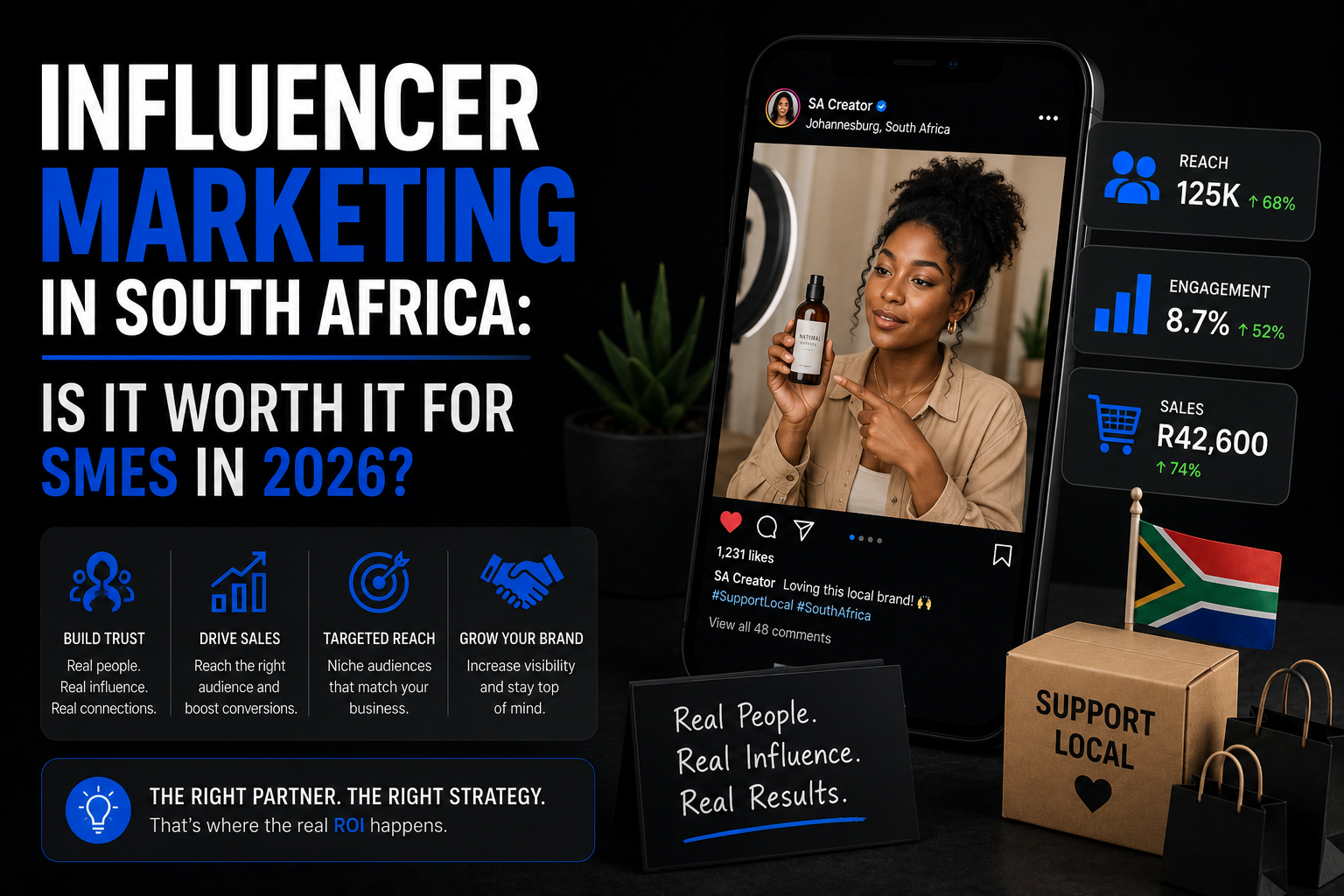
Influencer Marketing in South Africa: Is It Worth It for SMEs in 2026?
Influencer marketing in South Africa is no longer just for big consumer brands with agency-sized budgets. Nano and micro-influencers now make campaigns accessible to SMEs with a few thousand rand to spend, but that doesn’t mean every small business should rush in.
This guide covers what influencer marketing actually costs in South Africa, when it works for SMEs, and how to run a first campaign without wasting budget on the wrong partnership.
Quick Answer: Influencer marketing is worth it for South African SMEs when the goal is brand awareness, trust-building, or reaching a specific local audience, and when nano or micro-influencers are used instead of celebrities. It works less well for businesses needing immediate sales, since influencer content typically builds awareness first and conversions over time.
What Is Influencer Marketing, and How Does It Work in South Africa?
Influencer marketing means paying or partnering with a social media creator to promote a product or service to their audience. In South Africa, this ranges from a Johannesburg food blogger reviewing a restaurant to a Cape Town fitness creator promoting a supplement brand.
The value comes from trust. An audience that follows a creator’s daily content is generally more receptive to a recommendation from that person than to a traditional advert, particularly on Instagram and TikTok, the two platforms where South African influencer activity is concentrated.
Types of Influencers (Nano, Micro, Macro, Celebrity)
Influencers are typically grouped by follower count, and each tier suits a different budget and goal:
- Nano-influencers (1,000–10,000 followers) – highly engaged, niche audiences, most affordable
- Micro-influencers (10,000–100,000 followers) – strong engagement rates, good balance of reach and cost
- Macro-influencers (100,000–1 million followers) – wider reach, lower engagement rates, higher cost
- Celebrity influencers (1 million+ followers) – mass awareness, weakest direct engagement, highest cost
For most South African SMEs, nano and micro-influencers deliver the best return, since their audiences are smaller but far more likely to trust and act on a recommendation.
How South African Influencer Marketing Differs from Global Campaigns
South African influencer rates are considerably lower than US or UK equivalents, and engagement often skews higher on platforms like TikTok, where local trends move quickly. Campaigns also tend to rely more heavily on barter arrangements (free product in exchange for content) at the nano level, which suits SMEs without large marketing budgets.

How Much Does Influencer Marketing Cost in South Africa?
Influencer rates in South Africa vary by tier, platform, and content type. As a general guide:
Influencer Tier | Typical Rate per Post (ZAR) |
|---|---|
Nano (1K–10K followers) | Free product – R2,000 |
Micro (10K–100K followers) | R1,500 – R8,000 |
Macro (100K–1M followers) | R8,000 – R40,000 |
Celebrity (1M+ followers) | R40,000 – R250,000+ |
Rates increase for video content, usage rights (allowing the business to reuse the content in its own ads), and exclusivity periods. Most SMEs get the strongest return by working with three to five nano or micro-influencers rather than one macro-influencer, since this spreads reach across multiple trusted, niche audiences.
Is Influencer Marketing Worth It for SMEs? Pros and Cons
The honest answer depends on what the business is trying to achieve.
When It Works Well
- Building brand awareness in a specific city or niche audience
- Launching a new product and needing authentic, visual content
- Businesses in lifestyle categories: food and beverage, beauty, fashion, fitness, travel
- Generating content (photos and videos) the business can reuse in its own marketing
When It Doesn’t
- Businesses needing immediate, trackable sales, such as B2B services
- Very niche or technical products with no natural influencer audience
- Businesses with no budget for even nano-influencer product costs
- Campaigns run without any tracking, making it impossible to judge results
How to Run an Influencer Campaign on a Small Business Budget
A first influencer campaign doesn’t need a large budget or an agency retainer. These steps keep it manageable:
- Define one clear goal, such as awareness for a new product launch or foot traffic to a physical store.
- Identify 5–10 nano or micro-influencers whose audience matches your target customer, using hashtag and location searches on Instagram or TikTok.
- Reach out directly with a clear offer: free product, a flat fee, or both, along with what content you expect in return.
- Agree on deliverables in writing, including number of posts, usage rights, and posting dates.
- Provide a unique discount code or trackable link for each influencer so results can be measured individually.
- Review performance after 30 days and reinvest in the influencers who delivered the strongest engagement or conversions.
Measuring Results: What SMEs Should Track
Influencer marketing results should never be judged on follower count alone. Track these instead:
- Engagement rate – likes, comments, and shares relative to follower count, not raw numbers
- Referral traffic – website visits from unique tracking links per influencer
- Discount code redemptions – direct sales tied to a specific influencer
- Content usage value – the cost of producing similar photos or video in-house, for comparison
A campaign with modest reach but a high engagement rate and several code redemptions is a stronger result than one with huge reach and no measurable action.
Why South African Businesses Choose Blackdot Studios
Blackdot Studios helps South African SMEs build influencer campaigns into a broader digital marketing strategy, rather than running them in isolation. This includes setting up tracking links and discount codes, briefing content requirements that align with brand guidelines, and folding the resulting content into paid social and website assets.
Businesses wanting a coordinated approach can explore Blackdot’s Digital Marketing and Branding services, or speak to the team about integrating influencer content into an existing campaign.
Frequently Asked Questions
Is influencer marketing worth it for a small business in South Africa?
Yes, particularly for lifestyle categories like food, beauty, fashion, and fitness. Nano and micro-influencers make it affordable, often starting with free product exchanges, and typically deliver stronger engagement than paid social ads alone. It works less well for B2B services needing immediate, trackable sales.
How much do South African influencers charge per post?
Nano-influencers often work for free product or a small fee up to R2,000. Micro-influencers typically charge R1,500 to R8,000 per post. Macro-influencers range from R8,000 to R40,000, while celebrity-tier influencers can charge R40,000 to R250,000 or more per post.
Should SMEs use nano-influencers or celebrity influencers?
Nano and micro-influencers generally deliver better value for SMEs. Their audiences are smaller but far more engaged and trusting, and the cost per post is a fraction of celebrity rates. Working with several nano-influencers often outperforms one expensive celebrity post.
How do I find the right influencers for my business?
Search relevant hashtags and location tags on Instagram or TikTok to find creators already posting about your industry or city. Check engagement rate rather than follower count, and look at comment quality to confirm the audience is genuine and active.
How do I measure influencer marketing results?
Use a unique discount code or trackable link for each influencer so results can be attributed individually. Track engagement rate, referral traffic, and code redemptions rather than judging success on reach or follower count alone.
What platforms work best for influencer marketing in South Africa?
Instagram and TikTok are the strongest platforms for South African influencer marketing, with TikTok showing particularly high engagement for trend-driven content. YouTube suits longer-form reviews, while Facebook works better for reaching an older demographic.
Can influencer marketing replace paid advertising for an SME?
It works best alongside paid advertising rather than replacing it. Influencer content builds trust and awareness, while paid ads (including boosted influencer posts) extend reach and drive measurable conversions. Combining both typically outperforms using either alone.
Influencer marketing is worth it for most South African SMEs, provided expectations match the goal. Nano and micro-influencers make it accessible on a limited budget, particularly for lifestyle categories, but it suits brand awareness and trust-building more than immediate sales. Track engagement and conversions per influencer, start small with five to ten creators, and reinvest in what performs.
Ready to Grow Your Business Online?
Blackdot Studios helps businesses build powerful websites, improve search visibility, and generate more leads through strategic digital solutions.
Whether you need a new website, SEO strategy, branding, or digital marketing support, our team can help.
Contact Blackdot Studios today for a free consultation